

Grow Wealth with Core and Satellite Portfolio Strategy
Building a successful investment portfolio requires more than just picking a few stocks or mutual funds. It demands structure, strategy, and a clear understanding of how each component contributes to your financial goals. The Core and Satellite Portfolio Investment strategy is applicable in this situation.
At its essence, the Core portfolio acts as the solid foundation of your investments. It includes dependable, long-term holdings—such as index funds, government bonds, or blue-chip stocks—that are designed to offer consistency, low cost, and stability over time.
On the other hand, the Satellite portfolio encircles this core with investments that are more flexible, actively managed, or have a specific theme.
These may include sector funds, mid- and small-cap equities, or global ETFs. The purpose of the satellite is to capture high-growth opportunities while staying aligned with your broader goals.
When combined, this strategy provides the best of both worlds:
- Stability from the core
- Growth potential from the satellite
- And most importantly, risk-adjusted returns tailored to your unique profile
“The core and satellite portfolio approach allows investors to build a cost-effective, diversified portfolio while still capturing high-conviction ideas.”
Core and Satellite Portfolio Strategy for Equity and Fixed Income Investors in India
In today’s fast-changing markets, the Core and Satellite Portfolio Strategy remains a strong option. This strategy helps investors mix stability with opportunity. It keeps your investments on track during both calm and turbulent times.
This article looks at how Indian investors can use this approach for Equity and Fixed Income portfolios. We’ll provide practical tips for real-world use.
The Indian Thali Analogy: Investing with Balance
Think of your investment portfolio like a well-served Indian thali:
- The core is your dal-chawal-roti-sabzi — simple, nourishing, and essential.
- The satellite is the chutney, pickle, or dessert — adds zing, variety, and occasional indulgence.
A thali with only desserts would be unsatisfying. Similarly, a portfolio with only high-risk investments may collapse under volatility. But a thoughtful mix of core and satellite portfolio ensures your investment thali is both nutritious and enjoyable.
What is the Core and Satellite Portfolio Strategy?
This strategy breaks your investments into two layers:
- Core Portfolio: Your primary, long-term, stable investments.
- Satellite Portfolio: Tactical, dynamic investments designed to enhance returns.
By combining structure with flexibility, this approach encourages disciplined investing while allowing for alpha generation.
Core & Satellite Approach in Equity Allocation
Core Equity Portfolio (60–80%)
- Goal: Capital growth with stability.
- Investor Type: Long-term investors, retirement planners, risk-managed wealth builders.
- Suggested Instruments:
- Large Cap Mutual Funds – Consistent performance, lower volatility
- Flexi Cap / Multi Cap Funds – Diversified across market caps
- Mid & Small Cap Funds (Partial Allocation) – Moderate growth exposure
- Smart Beta Mutual Funds (Quality / Low Volatility) – Rule-based strategies without active fund manager bias
Satellite Equity Portfolio (20–40%)
- Goal: Alpha generation and tactical play
- Investor Type: Moderately aggressive to aggressive investors
- Suggested Instruments:
- Mid & Small Cap Funds – Tactical overweighting based on cycle
- Thematic / Sectoral Mutual Funds – Play on themes like EVs, BFSI, Infrastructure, Green Energy
- International Mutual Funds – Exposure to global brands, geographies (e.g., US Tech)
- PMS (Portfolio Management Services) – Concentrated high-conviction portfolios
- AIF Category III – Long-short, arbitrage, or thematic hedge funds for HNIs
- Smart Beta Mutual Funds (Alpha & Momentum) – Rule-based strategies targeting outperformance.
Practical Allocation Example – ₹10 Lakh Equity Portfolio
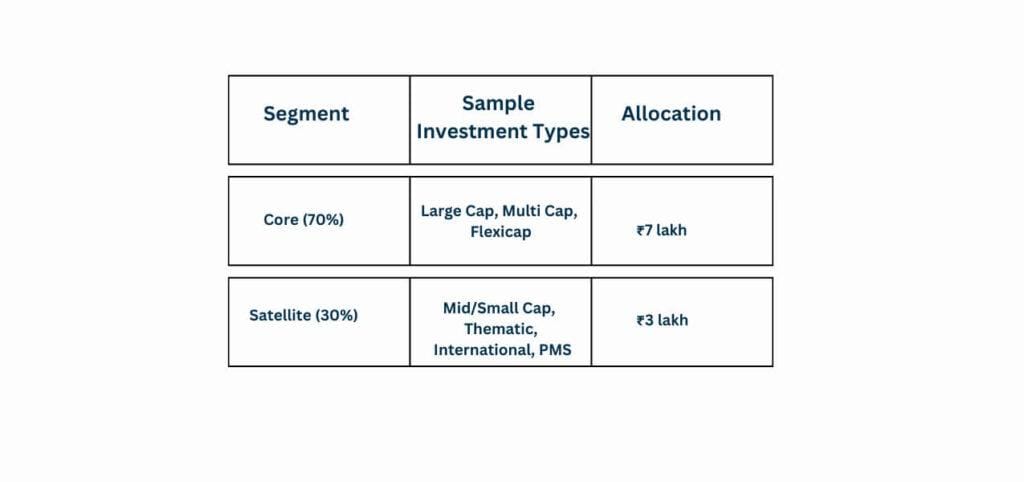
Core & Satellite Strategy in Fixed Income Allocation
Core Fixed Income Portfolio (70–85%)
- Goal: Capital preservation, safety, and liquidity
- Investor Type: All investors, especially retirees and conservative investors
- Suggested Instruments:
- Target Maturity Debt Mutual Funds – Defined tenure, predictable returns
- Gilt Funds / Government Securities – High safety, sovereign backing
- Bank Fixed Deposits – Reliable and secure
- PPF, EPF, VPF – Long-term compounding and tax benefits
- Senior Citizen Savings Scheme (SCSS) – Post-retirement regular income
Satellite Fixed Income Portfolio (15–30%)
- Goal: Yield enhancement and opportunistic allocations
- Investor Type: Investors with moderate risk appetite
- Suggested Instruments:
- REITs and InvITs – Infrastructure and real estate income sources
- Dynamic or Floating Rate Debt Funds – Suitable for uncertain rate cycles
- Credit Risk Funds – Higher yield with credit exposure
- Market-Linked Debentures (MLDs) – Structured tax-efficient returns
- Corporate Fixed Deposits – Better yield with credit check
- Non-Convertible Debentures (NCDs) – Medium-term corporate debt instruments
Practical Allocation Example – ₹5 Lakh Fixed Income Portfolio
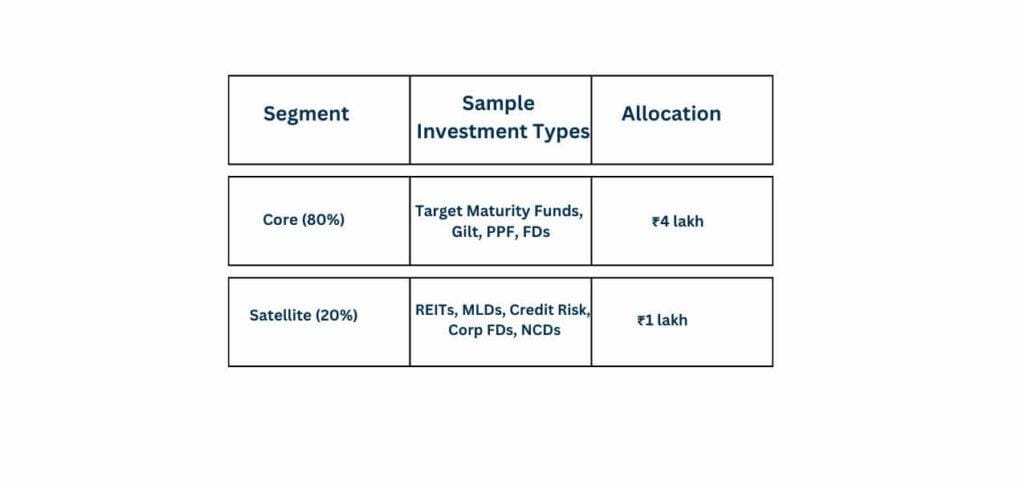
Gold & Silver – Strategic Allocations Outside Equity and Debt
Though not part of equity or fixed income portfolios, Gold and Silver are increasingly becoming integral to well-rounded portfolios. Here’s how to position them:
Gold – Core Portfolio
- Why: Long-term store of value, inflation hedge, negative correlation with equity
- Ideal Allocation: 5–10% of overall portfolio
- How to Invest: Physical Gold, Digital Gold
Silver – Satellite Portfolio
- Why: Industrial and energy-use driven metal, cyclical, more volatile than gold
- Ideal Allocation: 2–5% of portfolio for tactical gains
- How to Invest: Physical form or digital form
Benefits of the Core & Satellite Strategy
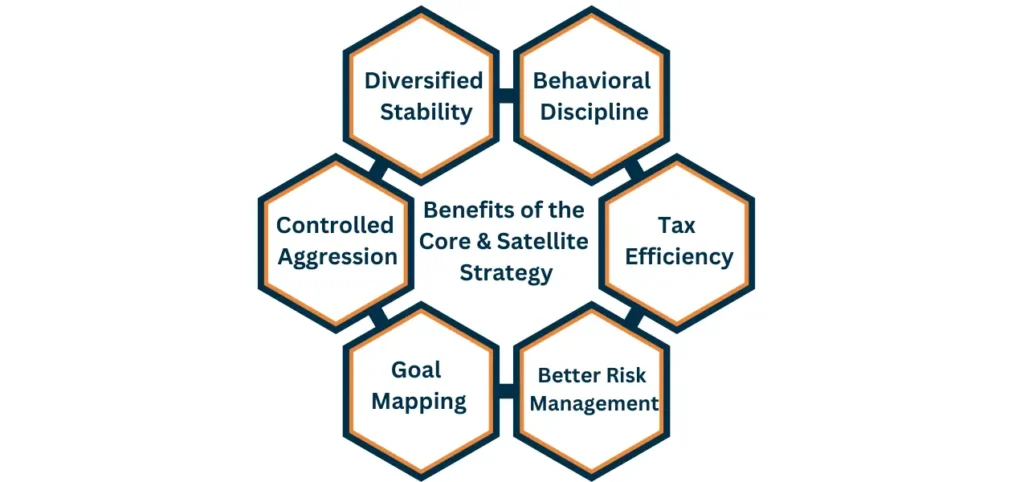
1. Diversified Stability
A strong core portfolio supports your investments with low-cost, reliable asset classes. This provides stability during market changes, reducing volatility and protecting your capital. Think of it as a house’s foundation—steady even in a storm. By diversifying across regions, sectors, and instruments, it keeps your portfolio balanced without being too cautious.
2. Controlled Aggression
The satellite portion adds agility and upside potential while keeping risk low for the entire portfolio. By allocating a smaller amount to high-conviction ideas or thematic plays, investors can seek returns without risking their overall financial safety. It’s not about being aggressive; it’s about being smart with risk management.
3. Goal Mapping
This strategy helps investors match parts of their portfolio to specific life goals. The core focuses on long-term, essential goals like retirement. Meanwhile, satellite investments target shorter-term or aspirational goals, such as travel, a second home, or legacy planning. It serves as a guide to keep your investments aligned with your financial vision.
4.Better Risk Management
By separating stable, low-volatility assets from tactical, opportunistic ones, investors can clearly assess and manage risk. The strategy helps avoid emotional decisions, particularly during market extremes. Risk is no longer an undefined fear—it becomes a calculable factor that is continuously monitored and adjusted as needed.
5.Tax Efficiency
Satellite instruments, such as Market-Linked Debentures (MLDs) and some debt funds, provide tax arbitrage opportunities. With good planning, investors can reduce their tax liabilities while still enjoying returns. When combined with long-term holding of core assets, this strategy leads to better post-tax gains. This is particularly crucial for high-income investors.
6.Behavioral Discipline
One of the silent killers of wealth is emotional investing—buying high, selling low, reacting to noise. The core-satellite approach instills discipline by keeping the core untouched during market noise, while giving the investor controlled freedom to explore ideas within the satellite. This structure brings clarity, confidence, and consistency to investment behavior over time.

When Should You Consider a Core and Satellite Portfolio Strategy?
The Core and Satellite portfolio approach works for all investors. It’s a flexible strategy that suits different financial goals and risk levels. If any of these describe you, this strategy might be a good match:
1)You Want to Play It Safe, but Also Grow Your Money
You like stable investments but don’t want to miss out on new opportunities like tech, real estate, or global stocks. The Core part keeps your money safe and steady, while the Satellite part gives you the chance to grow faster with smart bets.
2)You Have Financial Goals and Want a Plan That Works
Whether you’re saving for a house, your child’s education, or retirement, this strategy helps you match your investments to your goals. The Core focuses on long-term needs, and the Satellite lets you adjust based on what’s happening in the market.
3)You Dont Want to React to Every Market Change
Markets go up and down, but your money shouldn’t panic. This strategy keeps most of your money stable, so you don’t make emotional decisions. You can still make small changes in your Satellite when needed, without affecting the whole portfolio.
4)You Want Good Returns Without Too Much Risk
It’s not just about making more money — it’s about doing it safely. Your Core investments lower the risk, while the Satellite side gives you a chance to earn a little extra. It’s a smart way to balance your money.
5)You Want Good Returns Without Too Much Risk
As you grow older or your income changes, your portfolio should change too. This strategy lets you adjust your investments easily as your needs and risk levels change over time.
Implementing the Strategy: Steps for Indian Investors
- Set Clear Objectives: Define what you aim to achieve—retirement corpus, children’s education, etc.
- Determine Risk Appetite: Assess your comfort with potential losses.
- Choose Appropriate Instruments :
- Core: Index funds, PPF, EPF, government bonds.
- Satellite: Sectoral/thematic funds, international ETFs, direct equities.
- Allocate Assets Accordingly: Based on risk tolerance and goals.
- Regular Review: Monitor performance and rebalance the portfolio periodically. Focus on goal alignment, not daily NAVs.
Final Thoughts
The Core and Satellite Strategy gives your portfolio a foundation and wings. By applying it specifically to Equity and Fixed Income investments, you create a balanced, dynamic system that can weather market volatility while capitalizing on evolving opportunities.
Incorporating Gold as a core store of value and Silver as a tactical allocation further strengthens your long-term wealth strategy.
Looking to structure your portfolio using the Core & Satellite Portfolio Strategy?
Let WealthBeats Finserv help you craft a resilient and growth-oriented investment plan tailored to your goals
Get in touch today for a personalized consultation!
Call Now: +91-9625565403
FAQ:
The Core and Satellite Portfolio Strategy
An investment approach that combines two key components:
The Core portfolio serves as the foundation. It includes diversified, stable, long-term investments that match your financial goals and risk profile.
The Satellite portion is smaller and more adaptable. It lets you make tactical bets in high-growth or opportunistic areas to boost returns. This structure balances stability and performance optimization while keeping the portfolio aligned with your goals.
There’s no one-size-fits-all allocation. However, a common structure is:
Core: 60% to 80% of the portfolio.
Satellite: 20% to 40% Your allocation relies on your risk appetite, investment horizon, and financial goals. Conservative investors often choose a higher Core allocation. In contrast, aggressive investors might put more in the Satellite for potential alpha.
Yes, it is a flexible strategy that can be used across both equity and fixed-income assets.
In equity, the Core could include Large Cap and Multi Cap Funds, while Satellite may consist of Mid/Small Cap, Thematic, or International funds.
In fixed income Core holdings can be short- or medium-duration debt funds. Satellite holdings might include credit risk funds, dynamic bond funds, or target maturity funds for tactical chances. This setup promotes portfolio diversification and keeps an eye on risk-adjusted returns.
Core investments in equity aim to provide broad market exposure and stability. Examples include:
- Large Cap Mutual Funds (e.g., investing in top 100 companies)
- Multi Cap or Flexi Cap Funds (diversification across all market caps)
- Smart Beta Funds focused on Low Volatility or Quality factors
These instruments tend to be less volatile and more aligned with long-term wealth creation goals.
Satellite investments are intended to enhance returns or exploit specific market trends. Examples include:
- Mid Cap and Small Cap Funds (higher growth potential, but also higher volatility)
- Thematic or Sectoral Funds (e.g., pharma, tech, ESG)
- International Equity Funds (for global diversification)
- Momentum or Alpha Smart Beta Funds
- PMS/AIF strategies for HNIs seeking differentiated alpha
These are more dynamic and need active monitoring and review.
The portfolio should be reviewed at least once every 6–12 months. Rebalancing depends on:
- Significant deviation from your target Core-Satellite allocation
- Completion of financial milestones or goals
- Market events that warrant tactical changes
However, avoid frequent changes driven by short-term noise. A goal-based review framework helps maintain discipline and long-term focus.
This strategy offers a structured yet flexible framework. Benefits include:
- Clarity: Clear division between long-term investments and tactical bets
- Customizability: Adaptable to various goals (retirement, education, house purchase)
- Risk Management: Reduces overexposure to volatile instruments
- Performance Optimization: Satellite strategies can boost overall portfolio returns without compromising the core
It’s particularly useful in financial planning where aligning investments to goals, timelines, and risk profiles is critical.
Contact Us
Table of Contents

Vineet Baheti,CFP
With over 14 years of experience in wealth management, I am expertise in comprehensive financial planning, including tax planning, retirement planning, and goal-based planning for High-Net-Worth (HNI) and Ultra-High-Net-Worth (UHNI) clients. As a Certified Financial Planner (CFP, Certification Number: IN94288), I provide personalized strategies to help clients achieve financial security, optimize their tax positions, and plan for a prosperous retirement. My approach is centered around building tailored financial plans that align with individual’s unique goals, ensuring their long-term financial success.