

- Vineet Baheti
- 12 min Read
- No Comments
Tax Planning for Level Up Your Finances with Wealthbeats Finserv
Tax planning is the process of strategically analyzing your financial situation from a tax perspective to legally minimize your tax burden. It involves making informed decisions about your income, expenses, and investments to ensure you’re not paying more tax than necessary.
Our goal at Wealthbeats Finserv is to maximize your after-tax income and build wealth, all while staying compliant with the law. Think of it as a financial roadmap designed to navigate the complex world of taxes. Instead of scrambling at the last minute to save tax, effective income tax planning allows you to be proactive throughout the year.
Why Is Tax Planning Important?
Tax planning is important because it empowers you to take control of your financial destiny. Without it, you are at the mercy of the tax system, paying whatever is demanded of you, without exploring avenues to save.
It’s about being an active participant, not a passive bystander. It ensures that your hard-earned money works for you, rather than for the government. It’s also crucial for avoiding penalties and legal trouble that can arise from not paying your taxes properly or on time. For example, failing to pay advance tax payments can result in interest and penalties.
Key Takeaways
- Tax planning is a strategic and legal way to minimize your tax liability.
- It helps you save money, increase your savings, and optimize your investments.
- There are different types of tax planning—permissive, purposive, short-term, and long-term—each with its own focus.
- Utilize tax-saving options under 80C, such as ELSS, PPF, and term insurance, to reduce your taxable income.
- Don’t forget other deductions like the HRA exemption and those for health insurance and education.
- Always be proactive with your income tax planning to avoid last-minute stress and potential penalties.
- Strategic tax planning is a powerful tool for achieving long-term financial goals and ensuring a secure future.
Tax Planning examples
Let’s look at some practical examples of how tax planning works.
- Investing in ELSS: A person can invest with a high-risk appetite up to ₹1.5 lakh in an equity linked savings scheme and claim a deduction under Section 80C. This not only saves taxes but also has the potential to generate high returns.
- Home Loan: The principal and interest payments on a home loan are a great way to save tax. You can claim a deduction for the principal repayment under 80C and a separate deduction for the interest paid.
- Health Insurance: Paying premiums for a health insurance policy for yourself and your family allows you to claim a deduction under Section 80D.
- NPS: Contributing to the National Pension System provides an additional deduction of up to ₹50,000 under Section 80CCD(1B), over and above the ₹1.5 lakh limit of Section 80C. This is a powerful tool for strategic tax planning and retirement savings.
Tip: Ask yourself,
“Have I planned for taxes or am I panicking at year-end?”
“Panic costs more. Planning pays off.“
READ ALSO– How to Build an Emergency Fund in INDIA
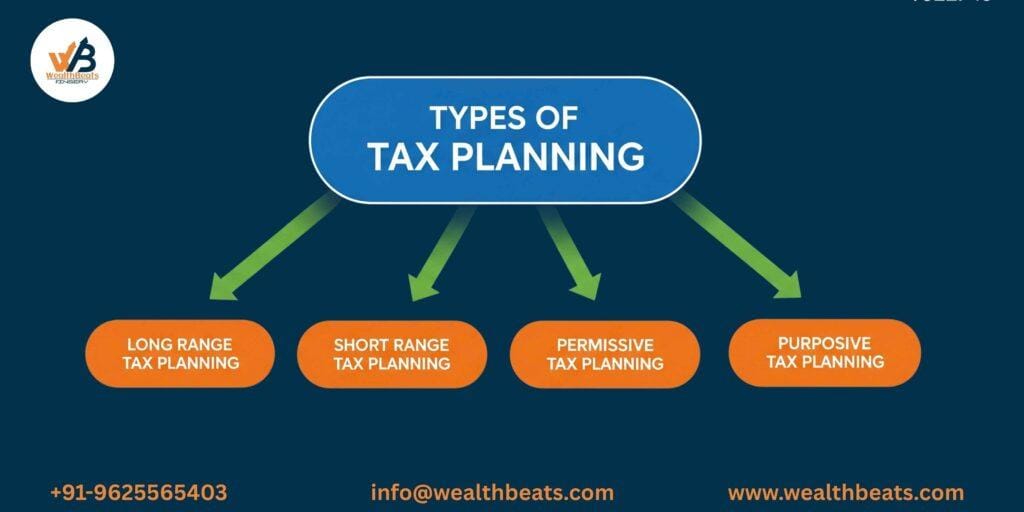
Types of Tax Planning for India
Tax planning isn’t a one-size-fits-all concept. It can be categorized into different types based on the approach and timeframe.
Permissive Tax Planning:
This involves utilizing the various exemptions, deductions, and incentives provided by the government in its tax laws. For example, claiming deductions under Section 80C or exemptions on House Rent Allowance (HRA exemption).
This is the most common form of tax planning and is considered a taxpayer’s right to take advantage of legal provisions to reduce their tax liability.
Contact Us
Table of Contents
Purposive Tax Planning:
This involves utilizing the various exemptions, deductions, and incentives provided by the government in its tax laws. For example, claiming deductions under Section 80C or exemptions on House Rent Allowance (HRA exemption).
This is the most common form of tax planning and is considered a taxpayer’s right to take advantage of legal provisions to reduce their tax liability.
Short-Term Tax Planning:
As the name suggests, this is a year-to-year strategy. It involves making financial decisions within a single financial year to lower the tax bill for that period. This could include things like making last-minute investments or paying off certain loans before the end of the financial year.
Long-Term Tax Planning:
This strategy spans several financial years and is focused on long-term financial health. It involves making investments in instruments with long lock-in periods, like a Public Provident Fund (PPF) or National Pension System (NPS tax benefit), which offer compounded tax benefits over time.
A key aspect of long-term planning is considering how your financial decisions today will impact your tax position for years to come, especially as you approach retirement.
Wealthbeats suggests You Some Keys to Consider in Tax Planning
To create an effective strategic tax planning strategy, you need to consider several factors that influence your tax liability.
Income Timing: This involves timing the receipt of your income to optimize your tax position. For example, if you anticipate being in a lower income tax slab next year, you might consider deferring some income to the next financial year to pay less tax.
Purchases & Expenses: Many expenses are eligible for deductions. For instance, home loan principal and interest payments, children’s tuition fees, and health insurance premiums can all reduce your taxable income.
Investment Selection: Choosing the right investment vehicles is crucial for tax planning. Options like Equity Linked Savings Scheme (ELSS), PPF, and NPS not only help you save for the future but also provide significant tax-saving options under 80C and other sections of the Income Tax Act.
Retirement Planning: A critical part of long-term financial planning is preparing for your post-work years. Using instruments like the NPS and other pension funds can provide you with tax benefits now while building a substantial Capital for your retirement.
Tax Filing Status & Deductions: Your marital status, number of dependents, and other factors can influence your tax liability. Understanding the deductions and exemptions available to you based on your specific situation is key. For instance, a salaried individual can claim a standard deduction, and those living in rented accommodation can claim the HRA exemption.
READ ALSO–Early Retirement Planning in India
Do you know about Benefits of Tax Planning
Tax planning helps you save more, invest smarter, reduce financial stress, and build long-term wealth. At WealthBeats Finserv, we turn tax efficiency into a strategy for financial freedom.
1. Lowered Tax Bill
This is the most obvious benefit. By making smart financial decisions, you can legally reduce the amount of tax you owe the government.
2. More Money Saved
The money you save on taxes can be reinvested, leading to a larger Capital over time. This is where the power of compounding truly shines, turning your tax savings into significant wealth.
3. Smartly Organizing Your Income
Tax planning helps you structure your income in a way that minimizes your tax burden. For example, your salary can be structured to include a higher HRA exemption or other tax-exempt components.
4. Maximizing Your Investments
By choosing the best tax-saving investments that also offer good returns, you can achieve both your financial goals and your tax-saving objectives simultaneously. For instance, ELSS funds offer a combination of tax benefits and wealth creation potential.
5. Freedom to Make Financial Choices
When you have a solid tax planning strategy in place, you have a clear picture of your financial situation. This gives you the flexibility and confidence to make sound financial decisions without being blindsided by unexpected tax demands.
What Are the Different Types of Tax Planning Strategies in India?
In India, tax planning strategies can be divided based on the laws and sections of the Income Tax Act.
- Short-Term vs. Long-Term: Short-term strategies focus on immediate savings, while long-term strategies, like investing in a PPF or NPS, build wealth over many years.
- Financial Planning-based: This is where tax planning is integrated into your overall financial goals. For example, if your goal is to buy a house, you can use the tax benefits of a home loan to help you get there faster.
- Permissive vs. Purposive: As discussed earlier, permissive is about using existing legal provisions, while purposive is about making financial decisions specifically to reduce your tax liability.
- Example-based: You can categorize strategies by the specific action you take, such as investing in the best tax-saving investments like ELSS funds or using deductions for your home loan.
Everyone should know The Basic Tax Planning Strategies?
The most basic tax planning strategies are simple yet effective but only if you follows Wealthbeats’s Financial planning tips
- Maximize Deductions: Start by fully utilizing the deductions available to you, especially the ₹1.5 lakh limit under Section 80C.
- Invest Wisely: Choose investment options that align with your risk profile and offer tax benefits. This is where you can explore options like ELSS, PPF, or tax-saving FDs.
- Claim Exemptions: Don’t forget to claim all available exemptions, such as the HRA exemption for rent paid.
- Pay Advance Tax: If your tax liability exceeds a certain limit (currently ₹10,000), make sure you pay your income tax advance in installments to avoid penalties.
Tax Planning have limitations that's why you need Wealthbeats Finserv
Tax planning may help you save, but it has its limits confusing laws, changing deductions, and one-size-fits-all solutions can leave you underprepared.
- Changes in Law: Tax laws can change frequently, making long-term strategies less predictable. For instance, a change in the income tax slab or a new deduction can alter your plan.
- Risk of Aggressive Planning: Overly aggressive tax planning can sometimes be seen as tax avoidance or evasion, which can lead to legal complications, penalties, or a tax audit.
- Lack of Flexibility: Some tax-saving investments, like certain FDs or ELSS, have a lock-in period, limiting your access to the funds.
Tip: Ask yourself,
“A fine is a tax for doing wrong. A tax is a fine for doing well.”
— WealthBeats Finserv
These are the reason for you need WealthBeats Finserv. Our expert advisors craft personalized, strategic tax plans that go beyond basic deductions helping you invest smartly, reduce stress, and build long-term wealth. Don’t just plan taxes, plan success with WealthBeats Finserv by your side.
People are Frequently Asked Us
The primary objective of taxation is to generate revenue for the government to fund public services like infrastructure, defense, and education. It also serves as a tool for wealth redistribution, economic stabilization, and social welfare.
Tax management refers to the day-to-day administrative aspects of complying with tax laws. This includes filing your tax returns correctly and on time, maintaining proper records, and responding to tax notices. While tax planning is proactive and aims to reduce tax liability, tax management is reactive and focuses on compliance.
Short-term tax planning is a strategy focused on minimizing tax liability within a single financial year. It involves making decisions close to the financial year-end to take advantage of available deductions and exemptions.
Under the new tax regime, individuals with a total income of up to ₹12 lakh can claim a tax rebate under Section 87A, effectively making their tax liability zero. However, if your income exceeds ₹12 lakh, the tax is calculated on the total income as per the applicable income tax slab.
Inflation can have a mixed impact. On one hand, the government often adjusts income tax slab rates for inflation, which could lower your tax bill. On the other hand, if your salary increases to keep up with inflation, it might push you into a higher tax bracket, increasing your tax liability. It also erodes the real value of your tax-saving investments, so it’s important to choose investments that offer inflation-beating returns, such as ELSS and other market-linked options.
Tax planning is an integral part of retirement planning. By strategically using tax-advantaged accounts like the NPS, you can build a substantial retirement corpus while enjoying tax benefits during your working years. It also helps you plan for the tax implications of your retirement income, such as withdrawals from pension funds or other investments, ensuring you don’t lose a significant portion of your savings to taxes later in life.
Unlock Your Financial Potential Today with Wealthbeats Finserv
As a Certified Financial Planner, Wealthbeats Finserv is dedicated to providing smart strategies for your wealth growth. Our expertise in Mutual Funds | SIPs | Tax & Retirement Planning, combined with expert insights and research-based investing, ensures you receive personalized and effective financial guidance.
Ready to start? We serve clients PAN India.
💬 DM for a free consultation and let’s create a personalized financial roadmap for you.
Final Advice
Financial goals turn dreams into plans. Start simple. Stay consistent. And don’t be afraid to ask for help.
“Struggling to plan your financial goals for 2025?
At WealthBeats Finserv, we believe everyone deserves a personalized money roadmap.
- Book a free 1-on-1 call with our financial experts
- Get a custom plan based on your income, dreams & risk
- Start your journey with confidence
- Book Free Consultation Call on : + 91-9625565403
People May Also Like



Vineet Baheti, CFP
With over 14 years of experience in wealth management, I am expertise in comprehensive financial planning, including tax planning, retirement planning, and goal-based planning for High-Net-Worth (HNI) and Ultra-High-Net-Worth (UHNI) clients. As a Certified Financial Planner (CFP, Certification Number: IN94288), I provide personalized strategies to help clients achieve financial security, optimize their tax positions, and plan for a prosperous retirement. My approach is centered around building tailored financial plans that align with individual’s unique goals, ensuring their long-term financial success.