
- Vineet Baheti
- 12 min Read
- No Comments
UPI Transaction Charges Applies in 2025 in India
The National Payments Corporation of India (NPCI) has announced new rules for UPI transactions charges starting August 1, 2025.
These changes affect daily UPI limits, transaction charges, and app-specific caps like PhonePe limit per day and Google Pay limit per day.
If you use UPI apps like PhonePe, Google Pay, Paytm, or BHIM, here’s that thing you need to know.
Why Did NPCI Introduce New UPI Rules?
UPI is India’s most widely used payment system, processing over 10 billion monthly transactions.
This massive growth has caused:
- Banking API overload
- Payment delays
- Security concerns
NPCI's Goals with These Updates
- Reduce backend load
- Improve payment security
- Increase transaction transparency
- Regulate auto-debits and balance checks
Key UPI Rule Changes from August 1, 2025
1. Balance Check Limit
- Old Rule: Unlimited
- New Rule: Maximum 50 times/day per app
- Reason: Reduce API overload
- Impact: If limit is exceeded, you can’t check balance on that app for 24 hours.
2. Auto Balance Display
After every transaction, your updated balance will auto-display — no need for frequent manual checks.
3. Bank Account Linking Limit
- Max 25 bank accounts/day can be linked per app (via mobile number or account fetch).
- Helps prevent fraudulent linking attempts.
4. Pending Transaction Status Checks
- Limit: 3 checks per transaction with 90-second gap between each.
- Purpose: Reduce system load.
5. Auto-Debit Timing Rules
Recurring payments (EMIs, SIPs, subscriptions) will be processed only in non-peak hours:
- Before 10:00 AM
- Between 1:00 PM – 5:00 PM
- After 9:30 PM
6. Payee Name & Bank Display
- Before confirming a UPI payment, you’ll see payee’s name + registered bank name.
- Purpose: Prevent fraud and wrong transfers.
UPI Transaction Charges Limits in 2025
Contact Us
Table of Contents
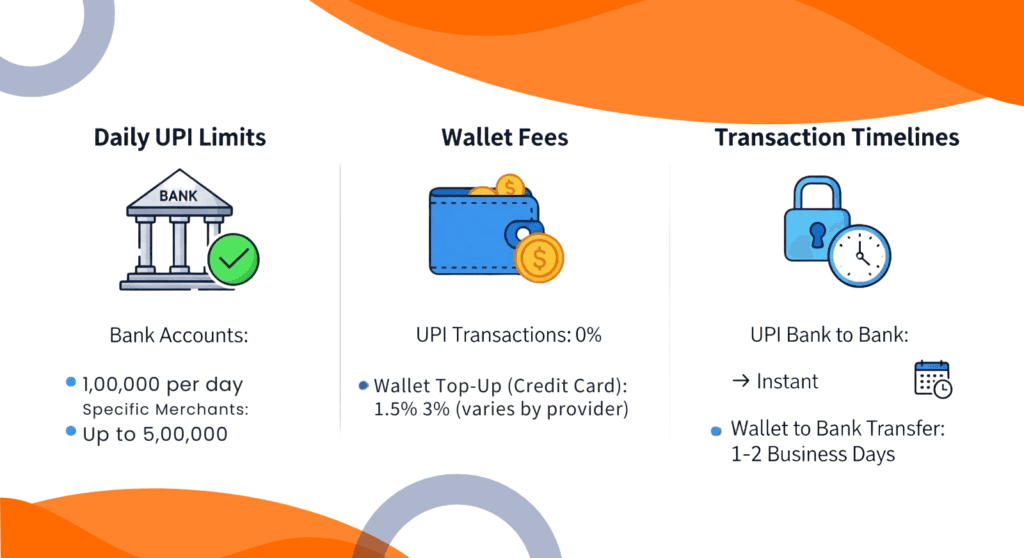
The NPCI UPI transaction Charges limits vary depending on the type of transaction:
- For standard UPI transfers, the limit is ₹1,00,000 per day.
- For capital markets, insurance, and remittances, the limit is ₹2,00,000 per day.
- For tax payments, education fees, IPO applications, and hospital transactions, the limit is ₹5,00,000 per day.
When it comes to bank-specific UPI limits:
- SBI, HDFC, Axis Bank, and ICICI Bank allow up to ₹1,00,000 per day.
- Punjab National Bank (PNB) has a lower limit of ₹50,000 per day.
- Union Bank of India permits ₹2,00,000 per day.
- ICICI Bank on Google Pay has a cap ranging between ₹10,000 and ₹25,000 per day.
IDFC Bank sets a weekly limit of ₹1,00,000 and a monthly limit of ₹30,00,000
PhonePe & Google Pay Limits
Follow your linked bank’s rules (generally ₹1,00,000/day).
UPI Transaction Charges in 2025
Still Free for Users:
- P2P (person-to-person)
- P2M (person-to-merchant via bank account)
💰 Wallet-based UPI payments (PhonePe Wallet, Paytm Wallet, Amazon Pay, etc.) — merchant pays interchange fee for transactions above ₹2,000.
Interchange Fee for Wallet-based UPI Payments
| Merchant Category | Fee |
| Fuel | 0.5% |
| Telecom, Utilities, Education | 0.7% |
| Supermarkets | 0.9% |
| Insurance, Mutual Funds, Govt, Railways | 1.0% |
| Others (>₹2,000 via Wallets) | Up to 1.1% |
Wallet Loading Fee
Loading more than ₹2,000: 0.15% fee (paid by wallet issuer to bank, not customer).
Quick Comparison – Old vs New Rules
| Feature | Old Rule | New Rule (Aug 2025) |
| Balance Check | Unlimited Times | 50/day/app |
| Auto Balance Display | Manually Show | Auto after each txn |
| Account Linking | Unlimited Times | Max 25/day/app |
| Pending Txn Status | Unlimited Times | Max 3 with 90-sec gap |
| Auto-Debits | Anytime | Non-peak hours |
| Wallet-based UPI Fee | Free of Cost | Merchant fee on >₹2,000 PPI payments |
Final Takeaway
- UPI remains free for most users.
- Daily limits vary by bank, not just by app.
- Wallet-based merchant payments above ₹2,000 will incur fees (for merchants only).
- These changes aim to make UPI faster, safer, and more reliable.
People May Also Like

PMS vs Mutual Fund: Key Differences and Which Is Better in 2025

How to Choose the Right Financial Planner in India (2025 Guide)
EPF vs NPS: Which is Better for Retirement Planning in India 2025?

Vineet Baheti, CFP
With over 14 years of experience in wealth management, I am expertise in comprehensive financial planning, including tax planning, retirement planning, and goal-based planning for High-Net-Worth (HNI) and Ultra-High-Net-Worth (UHNI) clients. As a Certified Financial Planner (CFP, Certification Number: IN94288), I provide personalized strategies to help clients achieve financial security, optimize their tax positions, and plan for a prosperous retirement. My approach is centered around building tailored financial plans that align with individual’s unique goals, ensuring their long-term financial success.