
Table of Contents

- Vineet Baheti
- 8 min Read
- No Comments
SIP vs Lump Sum: Which Investment Strategy is Better in 2025
If you’re asking SIP vs Lump Sum which is better, you’re not alone. In 2025, investors are re-evaluating these two popular strategies to maximize returns and reduce risks. Let’s break it down.
In 2025, investors across the board face a classic dilemma: do you invest your money through a Systematic Investment Plan (SIP) or a Lump Sum? The decision isn’t just a matter of convenience; it’s a strategic choice that can significantly impact your financial future.
To simplify this for you, we’ll break down both strategies in a straightforward manner. By the end of this blog, you’ll have a clear understanding of the key differences and be able to confidently decide which investment strategy suits your financial goals and risk appetite best in the current market landscape.
What is SIP? (Systematic Investment Plan)
In the debate of SIP vs Lump Sum which is better debate, Think of a SIP as a financial discipline tool. A Systematic Investment Plan involves investing a fixed, small amount of money at regular intervals typically monthly or weekly into a chosen mutual fund scheme. It’s like a recurring deposit for your investments. The amount is automatically debited from your bank account on a specific date, making it a hassle-free and consistent way to build wealth.
Benefits of SIP:
- Disciplined Investing: SIPs automate your investments, preventing you from making impulsive decisions or procrastinating. It’s a “set it and forget it” method that builds a strong saving habit.
- Rupee Cost Averaging: This is a crucial benefit, especially in a volatile market like the one in 2025. When the market is down, your fixed investment buys more units of the fund. When the market is high, it buys fewer units. Over time, this averages out your purchase cost, reducing the risk of investing all your money at a market peak.
- Long-Term Wealth Building: Thanks to the power of compounding, even small, regular investments can grow into a substantial corpus over the long term. Your returns start earning returns, accelerating your wealth creation journey.
What is Lump Sum Investment?
A Lump Sum investment is the opposite of a SIP. Instead of spreading your investment over time, you invest a large, one-time amount into a mutual fund or other financial instrument. This is the strategy you might consider if you receive a financial windfall, such as an annual bonus, a large inheritance, or a property sale.
Benefits of Lump Sum Investment:
- Potential for Higher Returns in Bullish Markets: If you invest a lump sum at the beginning of a rising or “bullish” market, your entire capital is exposed to the market’s upward movement from day one. This can lead to potentially higher returns compared to a staggered SIP investment.
- Immediate Compounding: Since your entire investment amount is deployed at once, it starts compounding immediately. This gives your money more time to grow, maximizing the compounding effect over your investment horizon.
SIP vs Lump Sum: Key Differences
Choosing between the two depends SIP vs lump sum which is better on your personal financial situation and goals. Here’s a quick comparison to help you understand the core differences:
Parameter | SIP (Systematic Investment Plan) | Lump Sum Investment |
Investment Style | Small, fixed amounts at regular intervals (monthly, weekly) | One-time, large investment |
Market Timing | No need to time the market; benefits from rupee cost averaging. | Requires good market timing to get the best returns. |
Risk Level | Lower risk as investments are spread out, reducing volatility. | Higher risk, as the entire amount is exposed to market movements at once. |
Returns | Delivers stable, long-term growth through compounding and averaging. | Can deliver higher returns if timed well, but also carries higher risk. |
Flexibility | Highly flexible; can be started, paused, or stopped at any time. | Less flexible; once invested, the full amount is locked in. |
Ideal Investor | Salaried individuals, beginners, and long-term planners. | Experienced investors or those with a large surplus fund. |
SIP vs Lump Sum Returns in 2025 (Example Calculation)
Let’s illustrate the difference with a hypothetical example for 2025.
Scenario: Two investors, Arjun and Priya, each have ₹10 lakh to invest for a period of 5 years.
- Arjun (Lump Sum Investor): He invests the entire ₹10 lakh at the beginning of the period.
- Priya (SIP Investor): She decides to invest ₹20,000 per month for 50 months (totaling ₹10 lakh).
Let’s assume a conservative average annual return (CAGR) of 12% for the mutual fund they both invest in.
- Arjun’s Lump Sum Investment:
- Formula: $FV = P \* (1 + r)^n$
- $FV = 10,00,000 \* (1 + 0.12)^5$
- Future Value (after 5 years): Approximately ₹17.62 Lakhs
- Total Returns: ₹7.62 Lakhs
- Priya’s SIP Investment:
- Formula: $FV = P \* [((1 + r)^n – 1) / r] \* (1 + r)$
- Where P is the monthly investment (₹20,000), r is the monthly rate (12% / 12 = 1%), and n is the number of months (50).
- Future Value (after 5 years): Approximately ₹14.07 Lakhs
- Total Returns: ₹4.07 Lakhs
In a consistent bull market, the lump sum investment clearly has a higher potential for returns because the entire corpus starts compounding from day one. However, this calculation is based on an average return. In reality, the market is volatile. A sudden market drop after Arjun’s investment could lead to a significant initial loss, which a SIP would have cushioned. This is where rupee cost averaging truly shines, making SIP a more reliable strategy for most investors.
Case Study: SIP vs Lump Sum Investment in 2025
Meet Ananya, a 30-year-old IT professional from Bengaluru. In January 2025, she received a bonus of ₹10 lakh. Like most investors, she was confused:
👉 Should she invest the entire ₹10 lakh as a Lump Sum or start a monthly SIP?
To understand better, she ran two scenarios with the same mutual fund that delivered an average annual return of 12% (CAGR).
Scenario 1: Lump Sum Investment
- Invested: ₹10,00,000 in January 2025
- Average CAGR: 12%
- Time Horizon: 10 years
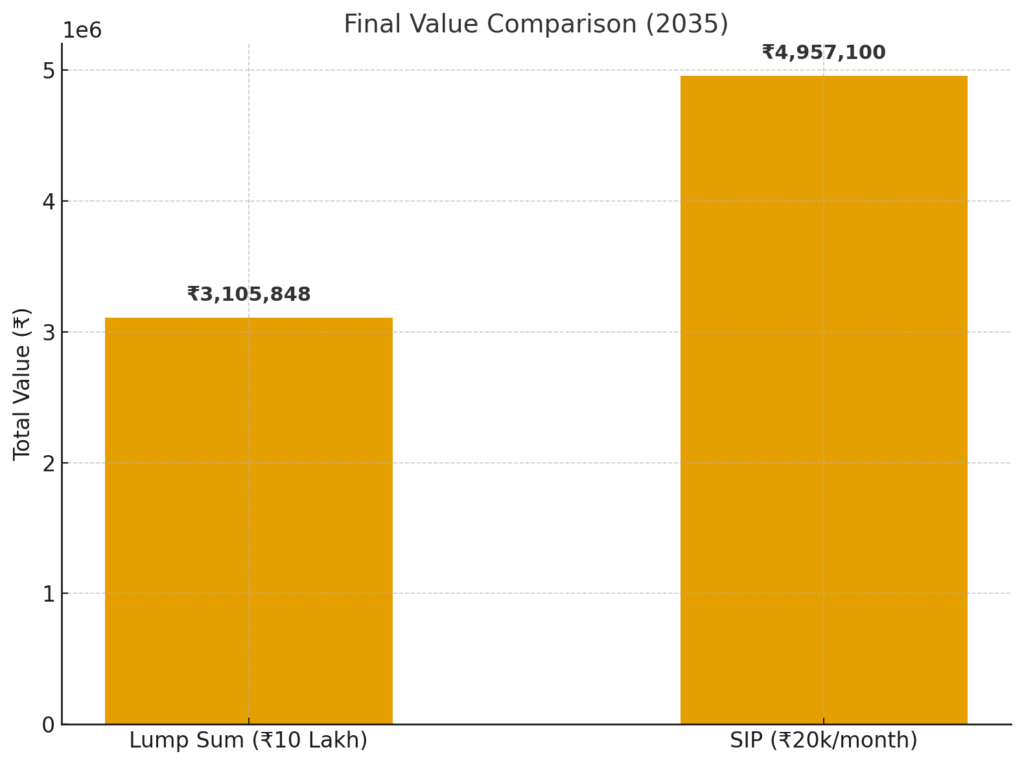
Value in 2035 = ₹31,06,000
👉 Her money grew 3X in 10 years due to compounding.
Scenario 2: SIP Investment
- Invested: ₹20,000 monthly (total ₹24,00,000 over 10 years)
- Average CAGR: 12%
- Time Horizon: 10 years
Value in 2035 = ₹46,00,000+
👉 Even though Ananya invested gradually, the continuous contributions made her wealth larger than the lump sum outcome.
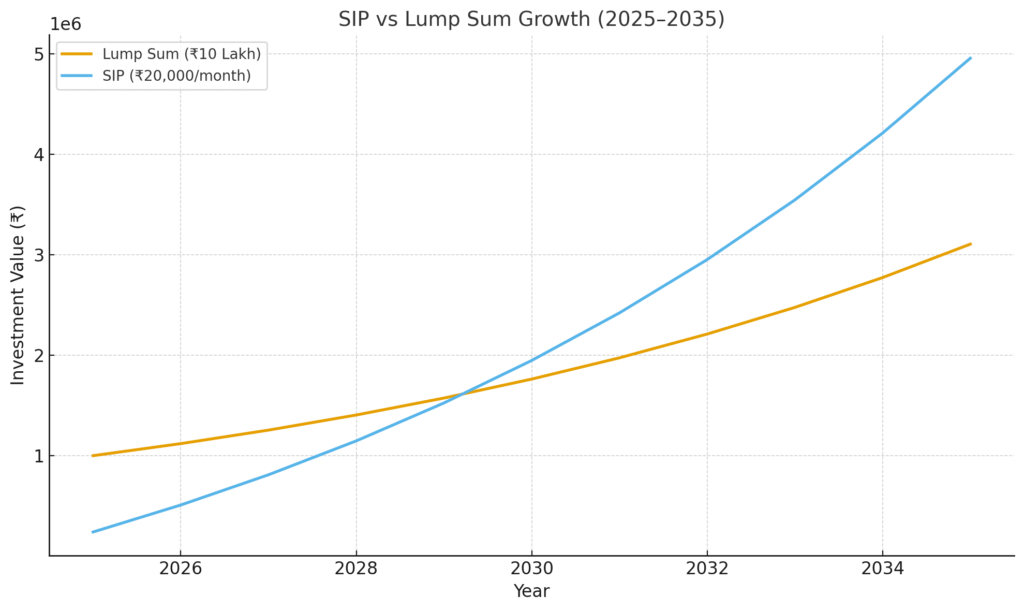
Insights from Ananya’s Case Study
- Lump Sum worked well for quick compounding but required perfect timing. If she had invested just before a market crash, returns could have dropped sharply.
- SIP gave her peace of mind, smoother returns, and a larger corpus because she kept adding money over time.
- A hybrid strategy could have been ideal: investing half (₹5 lakh) as Lump Sum and the rest via SIP, balancing growth and safety.
✅ Takeaway: In 2025, SIP remains the safer and more effective strategy for most investors, while Lump Sum works best if you have surplus money and confidence in market timing.
Which Strategy Works Best in Different Market Conditions?
The right choice is heavily influenced by the prevailing market conditions.
- Bull Market: In a strong, rising market, a lump sum investment is often the better choice. By deploying your entire capital, you get maximum exposure to the upward momentum. The earlier your money is in the market, the more it benefits from the rally.
- Bear/Volatile Market: When the market is falling or highly volatile, a SIP is the hands-down winner. The disciplined, staggered approach of a SIP allows you to buy more units when the prices are low. This “averages out” your cost of investment, positioning you for higher returns when the market eventually recovers.
- Neutral Market: In a sideways or neutral market, a SIP still offers a great advantage. It ensures you remain disciplined and consistently invest, even when market movements are not exciting. This avoids the trap of waiting for the “perfect time” to invest, a common mistake that can lead to missed opportunities.
SIP vs Lump Sum: Which One Should You Choose in 2025?
The decision ultimately comes down to your personal financial situation, risk tolerance, and investment goals. There is no one-size-fits-all answer.
- If you’re a salaried individual with a regular monthly income, a SIP is your best friend. It promotes financial discipline, aligns with your cash flow, and protects you from market timing risks. It’s the perfect way to save for long-term goals like retirement or your child’s education.
- If you have a large windfall, bonus, or savings, and are a seasoned investor with a good understanding of market cycles, a lump sum could be a rewarding option. It allows you to put your money to work immediately, potentially maximizing returns in a rising market.
- Consider a hybrid approach for a balanced strategy. You can use a SIP for your regular investments and set aside any surplus funds (like an annual bonus) to invest as a lump sum during a significant market correction or a market dip. This combines the discipline of a SIP with the high-return potential of a well-timed lump sum.
Pros and Cons: Quick Summary Table
Strategy | ✅ Pros | ❌ Cons |
SIP | – Disciplined investing habit<br>- Reduces market timing risk<br>- Rupee cost averaging<br>- Ideal for beginners<br>- Flexible & affordable | – Potential for lower returns in a strong bull market<br>- Compounding effect takes time to build momentum |
Lump Sum | – Potential for higher returns in bull markets<br>- Immediate compounding benefit<br>- Single, hassle-free transaction<br>- Suits experienced investors | – High risk if timed poorly<br>- Requires a large sum of money upfront<br>- Lack of flexibility after investment |
Conclusion
In the SIP vs Lump Sum which is better debate for 2025, it’s clear that both strategies have unique strengths. A SIP is a powerful tool for disciplined, long-term wealth creation, especially for those with a steady income and a low-risk appetite. A Lump Sum investment, on the other hand, is for the confident investor with surplus cash, willing to take on higher risk for the potential of greater returns.
Your decision should ultimately depend on your financial goals, personal risk appetite, and your outlook on the market. Whether you choose one or a combination of both, the most important thing is to start your investment journey today. The sooner you begin, the more time you give your money to grow. Start your Systematic Investment Plan (SIP) journey with us today!
FAQs Section
SIP is safer in 2025 due to market volatility. It spreads investments over time, reducing risk. Lump Sum can work if markets are undervalued and you have a high-risk appetite.
Lump Sum may give higher returns if invested at the right time since money compounds from day one. However, SIP often creates a larger corpus in the long run because of disciplined, continuous contributions.
👉 For retirement, SIP works better as it ensures consistent savings over decades. You can add Lump Sum whenever you get bonuses or windfalls to boost your retirement corpus.
Yes! A hybrid approach is the smartest in 2025. Invest part of your surplus as Lump Sum and continue SIPs for steady growth and risk management.
SIP is the best choice for beginners in 2025. It requires less market knowledge, avoids timing risks, and builds a disciplined investment habit.
People May Also Like

PMS vs Mutual Fund: Key Differences and Which Is Better in 2025

How to Choose the Right Financial Planner in India (2025 Guide)

EPF vs NPS: Which is Better for Retirement Planning in India 2025?

Vineet Baheti, CFP
With over 14 years of experience in wealth management, I am expertise in comprehensive financial planning, including tax planning, retirement planning, and goal-based planning for High-Net-Worth (HNI) and Ultra-High-Net-Worth (UHNI) clients. As a Certified Financial Planner (CFP, Certification Number: IN94288), I provide personalized strategies to help clients achieve financial security, optimize their tax positions, and plan for a prosperous retirement. My approach is centered around building tailored financial plans that align with individual’s unique goals, ensuring their long-term financial success.