
Table of Contents
- Vineet Baheti
- 5 min Read
Types of Life Insurance – Best Life Insurance in India 2025
Life is uncertain, and financial planning is the key to securing your loved ones’ future. In 2025, Indians are becoming more aware of financial stability, long-term planning, and wealth protection. Among all financial tools, Types of Life Insurance policies are considered one of the most trusted ways to ensure financial security.
But with so many different policies available, it can be confusing to understand which life insurance plan suits you best. Should you choose term insurance, ULIP, or whole life? Which company provides the best life insurance in India 2025?
In this detailed guide, we will explore all the Types of Life Insurance available in India, compare the best insurance companies, and help you make an informed decision.
What is Life Insurance?
Life insurance is a financial contract where you pay premiums to an insurance company, and in return, the company provides financial protection to your family in case of your death or other emergencies. Depending on the Types of Life Insurance, some policies also offer investment, savings, retirement benefits, and tax advantages.
In short, life insurance is not just about protection—it’s also about financial planning.
Key Things to Know About Life Insurance
Legal Agreement: It’s an official contract between you (the policyholder) and the insurance company.
Payout on Death: If something happens to you, your family (nominee) receives the promised amount.
Maturity Benefit: Some policies return money if you outlive the term, making it a smart savings option too.
Financial Security: Helps your family manage expenses, pay off loans, and achieve future goals.
Tax Benefits: Premiums and payouts may qualify for tax deductions under Sections 80C and 10(10D).
Different Plans, Different Goals: Each plan varies in coverage, benefits, and cost. Choose based on your income, goals, and life stage.
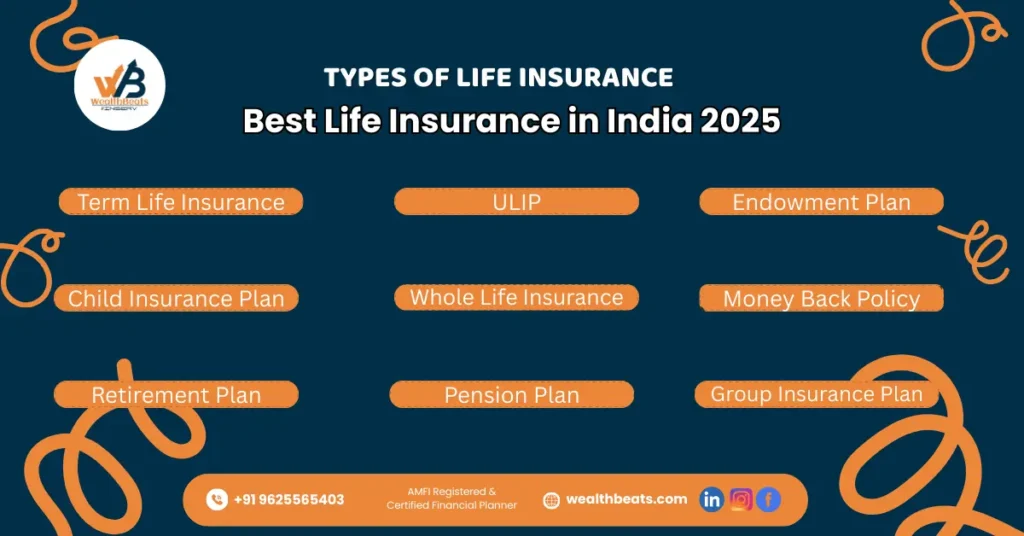
9 Different Types of Life Insurance Policies
Imagine you’re building a safety net for your family’s future—wouldn’t you want it to be strong, reliable, and tailored to your needs? That’s exactly what life insurance does. With so many options available, let’s explore the 9 Types of Life Insurance and see which one truly fits your journey.
| Type of Life Insurance | What It Offers | Payout Structure | Key Features |
|---|---|---|---|
| Term Life Insurance | A basic protection plan at the lowest premium | A lump sum is given to the nominee if the policyholder passes away during the policy term | High coverage, fixed premium, optional riders, but no maturity benefit |
| Unit Linked Insurance Plan (ULIP) | Life cover plus investment in market-linked funds | The nominee gets the fund value on death, or you receive the fund value on maturity | Combines insurance and investment, minimum 5-year lock-in, option to switch funds |
| Endowment Plan | Life insurance with guaranteed savings | Either the maturity amount or death benefit is paid | Low-risk savings, fixed returns, bonuses may apply, ideal for goal-based planning |
| Child Insurance Plan | Life cover and savings to secure your child’s future | Lump sum on maturity or in case of a claim; premiums waived if the parent dies | Builds an education fund, dual benefits, and lock-in till the child turns 18 or 21 |
| Whole Life Insurance | Coverage for your entire lifetime (up to 99–100 years) | Payout is made to the nominee when the policyholder dies | Lifelong protection, cash value in some plans, option to take a loan |
| Money Back Policy | Life cover with regular payouts during the policy term | Periodic survival payouts plus a lump sum on maturity | Ensures liquidity, survival benefits, fixed-term cover, bonus additions |
| Retirement Plan | Helps build a retirement corpus for future needs | Lump sum at vesting, followed by annuity payments | Tax benefits, guaranteed vesting, mix of lump sum and pension |
| Pension Plan | Provides a steady income after retirement | Lifetime monthly or yearly annuity payments | Ensures financial stability in old age, joint life option, immediate or deferred annuity |
| Group Insurance Plan | Covers many individuals under one policy | Payout made to the member’s nominee as per terms | Affordable bulk premiums, ideal for employees/members, additional riders available |
The wide range of Types of Life Insurance available today shows how fast India’s insurance sector is growing. Over the past two decades, the domestic life insurance market has expanded at a CAGR of 17% and is expected to reach nearly ₹19,30,290 crore (US$222 billion) by FY26.
In FY24 alone, the industry saw a 5.1% year-on-year rise in New Business Premium (NBP), touching ₹3.97 lakh crore (US$46.5 billion). Individual NBP grew even faster—by 11%—to ₹1.74 lakh crore (US$20.36 billion). This growth is driven by over 11 lakh new insurance agents and rapid digitisation, which have made life insurance more accessible than ever before.
Each of the different Types of Life Insurance is designed for a specific purpose—whether it’s protecting your family, building wealth, funding your child’s education, or ensuring a regular income after retirement. Choosing the right policy carefully ensures that your insurance plan aligns perfectly with your financial goals and life journey.
Confused about which Types of Life Insurance suit you best? At WealthBeats Finserv, we help you compare policies, understand benefits, and choose the right plan tailored to your goals.
Start your journey to financial security today with expert guidance from by contacting us!
Term Insurance
Term insurance is the simplest and most affordable type of life insurance. It provides a fixed payout (sum assured) to your nominee if you pass away during the policy term. To keep it active, you pay regular premiums (monthly, quarterly, or yearly). Unlike savings-linked plans, term insurance doesn’t offer maturity benefits unless you opt for a return of premium feature. With its low cost and pure protection focus, it’s one of the best ways to secure your family’s financial future.
Term Insurance with Critical Illness Rider
This optional add-on provides a lump sum payout if you are diagnosed with a serious illness like cancer, heart attack, or stroke during the policy term. It helps cover treatment and recovery expenses, while the base life cover remains intact.
Term Insurance with Return of Premium (TROP)
TROP plans combine protection with value. If you survive the policy term, all premiums are returned as a maturity benefit. If not, your nominee still gets the sum assured. Though slightly more expensive, these plans appeal to those who want both protection and money-back benefits.
Unit Linked Insurance Plans (ULIPs)
A ULIP is a unique type of life insurance that combines protection with investment. When you pay premiums, a portion secures your life cover, while the rest is invested in funds—equity, debt, hybrid, or money market—based on your goals and risk appetite.
ULIPs come with a five-year lock-in, making them ideal for long-term goals like retirement planning, your child’s education, or wealth creation. One of their biggest advantages is fund-switching flexibility, which lets you shift between funds without tax impact, helping you adapt to changing markets.
They also allow partial withdrawals after the lock-in, providing liquidity for short-term needs. While they offer growth opportunities, remember the investment risk lies with the policyholder. ULIPs are also transparent, with clear disclosures on fund value, NAV, and charges, ensuring clarity throughout your journey.
Endowment Plan
An endowment plan is a type of life insurance that combines protection with savings—so you get the best of both worlds. It not only secures your family’s future but also helps you build a guaranteed fund for long-term goals.
Here’s how it works:
If the policyholder passes away during the term, the nominee receives the death benefit.
If the policyholder survives the full term, they get the maturity amount, which includes guaranteed payouts plus bonuses (if it’s a participating plan).
👉 For example, imagine buying an endowment plan with a 20-year term and a sum assured of ₹10 lakh. If something happens during the policy period, the nominee gets ₹10 lakh. But if you outlive the policy, you’ll receive the maturity value along with any bonuses—so either way, there’s a benefit.
Because endowment plans are low-risk and non-market-linked, they’re perfect for people who want safe, guaranteed returns for goals like retirement, children’s education, or future savings.
Child Insurance Plans
A child insurance plan combines life cover with long-term savings to secure funds for your child’s key milestones like education or marriage. In these plans, the parent is the life assured and premium payer, while the child is the beneficiary.
A key benefit is that if the parent passes away, future premiums are waived, yet the policy continues. On maturity (when the child turns 18 or 21), the payout can be a lump sum, periodic income, or even ULIP-based growth.
Example: A parent who invests in a ₹10 lakh child plan for their 5-year-old can ensure that when the child turns 18, funds are ready for college, regardless of life’s uncertainties. Some plans also allow partial withdrawals for added flexibility.
Whole Life Insurance
Whole life insurance is one of the most comprehensive types of life insurance because it provides coverage for your entire life—up to 99 or 100 years. The death benefit is paid to your nominee whenever the policyholder passes away, offering lifelong protection. This plan is perfect for legacy planning or securing dependents for the long term.
Premiums can be paid for the entire policy or a limited period (e.g., 10–15 years). Many types of life insurance in this category also build cash value, and participating policies may include bonuses. Some plans provide a surrender or maturity benefit if the policy continues beyond the term.
Example: A 35-year-old buying a whole life insurance plan can ensure an assured payout for their children, leaving behind a strong financial legacy.
Money Back Policy
A money-back policy is a popular type of life insurance that combines life cover with regular survival benefits, making it ideal for those who want liquidity during the policy term. With this plan, the policyholder receives a percentage of the sum assured at fixed intervals. For example, in a 20-year plan, you might get 20% every five years and the remaining 40% at maturity.
Even with these periodic payouts, the policy still provides a death benefit. If the insured passes away during the policy term, the nominee receives the full sum assured, regardless of the payouts already made. If the policyholder survives till the end, they also get the maturity benefit, including any bonuses in participating plans.
This makes money-back policies one of the most flexible types of life insurance, especially for short- to mid-term financial goals like children’s education, paying EMIs, or meeting personal expenses. Unlike endowment plans, which pay benefits only at maturity, money-back plans give regular returns while keeping your family protected throughout the policy term.
Retirement Plans
Retirement plans are a key type of life insurance designed to help you build a retirement corpus and ensure a steady income during your golden years. These plans work in two phases: the accumulation phase, where you invest premiums regularly to grow your savings, and the payout phase, where the accumulated corpus provides a regular income.
At retirement (vesting), you can withdraw part of the corpus as a lump sum (commuted value) and use the rest to purchase an annuity. You can choose between a deferred annuity (income starts after a set period) or an immediate annuity (income starts right away). Flexible payout options include lifetime income, joint-life annuity, or return of purchase price.
For example, saving ₹5,000 per month for 20 years could help generate a monthly pension of ₹30,000 post-retirement. Additionally, premiums paid toward retirement plans qualify for tax benefits under Section 80CCC of the Income Tax Act, with tax rules applying at maturity.
Pension Plans
Pension plans are a type of life insurance designed to provide a steady income after retirement by converting a lump sum into regular pension payments. Unlike retirement plans that focus on building savings, pension plans prioritise the income phase once you retire.
These plans can be single-premium (invest a lump sum) or systematic contribution plans (accumulate funds over time). At vesting, the corpus is used to purchase an annuity, which pays monthly, quarterly, or annual income.
You can choose different annuity options, such as a life annuity, joint-life annuity, or annuity with return of purchase price to your nominee. For example, a 60-year-old investing ₹10 lakh in a pension plan might receive around ₹6,500 per month for life, ensuring long-term financial stability.
Group Insurance Plans
Group insurance plans are a type of life insurance that provides coverage to multiple members under a single policy, typically offered by employers or associations. The employer or group administrator acts as the master policyholder, while employees or members are automatically insured.
Coverage can be uniform (e.g., ₹5 lakh each) or vary based on salary or designation. One major advantage of these types of life insurance is affordability—premiums are usually low, paperwork is minimal, and most members may not need medical checks. Coverage generally ends if a member leaves the company or group.
For example, a company may offer ₹5 lakh in group term insurance to every employee. Some plans also include add-ons like accidental death or critical illness cover and can be fully employer-funded or contributory.
A Step-by-Step Guide to Purchasing Life Insurance in India
Buying the right types of life insurance in India requires careful planning to secure your family’s financial future. Start by assessing your financial obligations and those of your dependents. Tools like a life insurance calculator can help determine the coverage you need based on your family size, income, and future goals.
Next, understand the different types of life insurance available, including term plans, retirement plans, endowment policies, ULIPs, and money-back options. Each has its benefits and restrictions, so knowing which suits your needs is crucial.
Choose a reliable insurance provider by checking their financial stability, customer service, and claim settlement ratio. You can also use online tools like a term insurance calculator or retirement calculator to estimate premiums and retirement corpus requirements.
When applying, provide accurate personal details and complete any required medical tests promptly. Ensure all necessary documents, such as birth certificates, bank statements, or medical reports, are attached. Review your policy carefully to understand coverage, limitations, premium terms, and available riders.
Pay your premiums on time using your preferred method to keep the policy active. Once verified, the insurance company will issue your policy documents—check them for accuracy. In case of a claim, share all required information promptly for smooth processing.
For hassle-free guidance on selecting and managing your types of life insurance, trust WealthBeats Finserv, your partner in smart financial planning services and secure life coverage.
How to Choose the Right Type of Life Insurance Policy in India
Selecting the right type of life insurance in India depends on your financial goals, responsibilities, and affordability. Your ideal plan may vary at different life stages—from young professionals securing their first income to parents planning for their children’s education or retirees ensuring steady income. NRIs should also consider currency risk, international claim settlement, and tax implications.
Identify Your Life Goals
The purpose of life insurance differs for everyone. It could be replacing lost income, funding a child’s education, covering loans, or building a retirement corpus. Understanding your primary objective helps narrow down the suitable types of life insurance and benefit structures.
Determine the Sum Assured
The sum assured is the guaranteed amount your nominee receives in case of your demise. Experts suggest coverage of at least 10–15 times your annual income, adjusted for debts and future expenses. Adequate coverage ensures your family can maintain their lifestyle, clear liabilities, and achieve long-term goals.
For example, someone earning ₹12 lakh per year with a home loan may need a cover of ₹1.2–₹1.5 crore. Online term insurance calculators can help estimate a personalised sum assured based on your finances.
Choose the Right Policy Term
Select a policy duration aligned with the time your dependents will become financially independent. Early purchase is advantageous, as it locks in lower premiums and provides long-term protection.
Opt for Relevant Riders
Riders are optional add-ons that enhance your base policy. Popular options include critical illness cover, accidental death benefit, and waiver of premium on disability. Choose riders based on health, lifestyle risks, and budget to expand protection.
Verify Insurer Credibility
The reliability of the insurer is as important as the policy itself. Look for insurers with a high claim settlement ratio (over 95%), strong solvency, and good customer service. HDFC Life, for example, has a claim settlement ratio of 99.68% for FY 2024–25. Reviewing IRDAI reports and independent ratings ensures stability and smooth claim settlements.
Types of Term Insurance Coverage
Common coverage options include:
₹50 Lakh Term Insurance
₹75 Lakh Term Insurance
₹1 Crore Term Insurance
₹1.5 Crore Term Insurance
₹2 Crore Term Insurance
₹5 Crore Term Insurance
Using tools like online term insurance calculators, you can find coverage that matches your income, debts, and long-term goals.
For hassle-free guidance and customised recommendations on types of life insurance, trust WealthBeats Finserv, your partner for smart Wealth Management services and secure life coverage.
FAQs on New GST Rate Cuts 2025
India offers several types of life insurance, including Term Insurance, Endowment Plans, ULIPs (Unit Linked Insurance Plans), Money-Back Policies, and Retirement Plans. Each plan serves different financial goals and protection needs.
The sum assured should ideally be 10–15 times your annual income, adjusted for loans, debts, and future expenses. Online term insurance calculators can help estimate a personalised coverage.
Yes. Premiums paid for life insurance policies are eligible for deduction under Section 80C up to ₹1.5 lakh per year. Critical illness riders linked to life insurance are also eligible under Section 80D.
Yes. Death benefits are fully tax-free for nominees. Maturity proceeds from ULIPs or other policies may be tax-free if conditions under Section 10(10D) are met.
Riders enhance your base policy by covering additional risks like critical illness, accidental death, or waiver of premium in case of disability. They provide extra protection tailored to your lifestyle and health.
Look for insurers with a high claim settlement ratio, strong solvency, and reliable customer service. Checking IRDAI reports and independent ratings ensures your provider’s credibility.
Yes. NRIs can buy life insurance in India, but they should consider currency risk, international claim settlement, and tax implications before selecting a plan.
Choose the right types of life insurance for your financial goals, pay premiums on time, add health or critical illness riders if needed, and ensure policy compliance under Sections 80C, 80D, and 10(10D).
Yes. If you stop paying premiums before the minimum required period, you may lose prior tax deductions, and previously claimed deductions could be added back to your taxable income.
WealthBeats Finserv provides expert guidance on selecting the right types of life insurance, calculating sum assured, understanding riders, and maximising tax benefits, ensuring complete financial protection for your family.
People May Also Like
PMS vs Mutual Fund: Key Differences and Which Is Better in 2025
How to Choose the Right Financial Planner in India (2025 Guide)
EPF vs NPS: Which is Better for Retirement Planning in India 2025?

Vineet Baheti, CFP
With over 14 years of experience in wealth management, I am expertise in comprehensive financial planning, including tax planning, retirement planning, and goal-based planning for High-Net-Worth (HNI) and Ultra-High-Net-Worth (UHNI) clients. As a Certified Financial Planner (CFP, Certification Number: IN94288), I provide personalized strategies to help clients achieve financial security, optimize their tax positions, and plan for a prosperous retirement. My approach is centered around building tailored financial plans that align with individual’s unique goals, ensuring their long-term financial success.